Lovable’s ₹860 Crore Revenue: A Startup Success Story

A company called Lovable just added ₹860 crore in revenue in a single month — February 2026. They did it with 146 employees.

That works out to ₹23 crore in revenue per person. To put that in perspective, most successful software companies consider ₹1.7–2.5 crore per employee a healthy benchmark. Lovable is doing roughly 10x that.

So what do they actually make? Lovable is a “vibe coding” tool — you describe what you want to build in plain English, and it builds you a working app or website. No coding required. It’s been popular with small businesses and individual creators, but big companies like Klarna and HubSpot are now using it too.

The growth is unusually fast, even by startup standards.

Lovable hit ₹860 crore in annual revenue last July. Then ₹1,720 crore in November. Then ₹2,580 crore in January. Then ₹3,440 crore in February. Each milestone is coming faster than the last.

The small team is the real story.

Most companies at this revenue level have thousands of employees. Lovable has 146. That’s possible because the product itself runs on AI — meaning the software does work that would normally require a much larger team to build and support.

This is what people mean when they say AI is changing how companies are built. It’s not just about chatbots. It’s about a small group of people being able to build and run something at a scale that simply wasn’t possible before.

Whether Lovable can hold this position — especially as bigger players like OpenAI and Anthropic eye the same market — is the open question.

But right now, the numbers are hard to ignore.

The salon industry is ₹1.5 lakh crore. And you’re still booking appointments over WhatsApp. LUZO fixed that

LUZO — Book Your Bliss

“Right now everything is available at the click of a button — from the prettiest dress to fancy shoes, from your everyday grocery to your favourite food. Then why not the experience of a Spa and Salon?” — That’s how LUZO was born.

What is LUZO?

LUZO is your one-stop solution for all things salon, spa, and dermatology. The LUZO app allows customers to browse, book, and pay for salon, spa, and aesthetic dermatology clinic bookings with exclusive offers, available across Mumbai, Pune, Bengaluru, Delhi-NCR, Hyderabad, Chennai, and many other cities — with more than 3,000 options to choose from. CEO VINE

It shows you all the salons and offerings in your vicinity, letting you handpick the one you desire.

The process is simple:

  • Add the service to your cart
  • Select your preferred time and service
  • Payment through app (UPI,cards, NB etc)

Voilà — your appointment is done, and it’s that simple.

Funding Journey

LUZO has raised a total funding of $954K over 3 rounds. Its first funding round was on October 14, 2022. Tracxn

Here’s how the journey unfolded:

Round 1 — Pre-Seed (2022): LUZO raised $250,000 in a pre-seed funding round led by 100X.VC, with participation from angel investors including Yash Kotak (Founder of Jumper.ai) and Kabir Kulkarni. Entrepreneur

Round 2 — Pre-Seed (2023): LUZO raised INR 2.06 Cr as part of its second pre-seed round, further strengthening its position in the salon and spa marketplace. KeeVurds

Round 3 — Seed (May 2025 — Latest): Salonsurf Ventures, the parent company of LUZO, raised $550,000 (approximately ₹4.6 crore) in a seed funding round led by early-stage venture firm Enrission India Capital. The round also saw participation from strategic investors, including the founders of Swiggy Dineout and jewellery brand Orra.

What’s the Vision?

Co-founder Anurav Dave summed it up clearly: “We want luxury wellness to be accessible and effortless. This investment underlines our future stage of development as we take the next leap of growth with deeper reach and enhanced user experience driven by technology.” Silicon India

With more than 65% of India’s population under 35 and a growing appetite for quality wellness services, the founders see a long growth runway for digital innovation in this space. Silicon India

The Market Opportunity: India’s beauty and wellness services market is estimated to be worth over $20 billion, with a significant share still fragmented and unorganised — exactly the inefficiency LUZO is built to solve. Indian Startup News

Founded: 2021 | Headquarters: Mumbai, India | Founders: Anurav Dave, Nikhil Kalwani & Maan Jetley

LPG Supply Chain Disruption: Threat to Indian Restaurants

The Middle East conflict has choked commercial LPG supply chains, pushing India’s 5 lakh restaurants — and the millions who depend on them — to the brink of shutdown.

India’s restaurant industry is staring down a crisis that has nothing to do with food quality, customer footfall, or economic slowdown — it stems from a conflict raging thousands of kilometers away.

The ongoing war in the Middle East has disrupted global energy supply chains so severely that commercial LPG cylinders — the lifeblood of Indian kitchens — are becoming dangerously scarce.

The Crisis at a Glance

According to Sagar Daryani, President of the National Restaurant Association of India (NRAI) and co-founder and CEO of Wow! Momo Foods, as many as 50 to 60 per cent of India’s approximately 5 lakh restaurants could be forced to shut their doors within the next two to three days if the supply of commercial LPG cylinders is not restored.

This is not merely a supply chain hiccup. It is a full-blown crisis that threatens the livelihoods of millions — from restaurant owners and chefs to delivery personnel, suppliers, and daily wage workers who depend on the food service ecosystem.

The Middle East Connection

India imports a significant portion of its LPG from the Middle East — particularly from Saudi Arabia, Qatar, and the UAE. Any geopolitical disruption there becomes a direct threat to India’s domestic supply, and that is exactly what is happening right now.

The ongoing conflict, roughly 3,000 km from India’s shores, has disrupted shipping lanes, slowed tanker movements, jacked up freight costs, and created widespread uncertainty among energy importers. Insurance premiums for cargo ships passing through conflict-adjacent waters have surged.

Some suppliers have scaled back operations or delayed deliveries — triggering a cascading shortage felt at the most ground level: the kitchen of a neighborhood restaurant.

Panic, Hoarding & Black Marketing

What makes the current situation particularly dangerous is not just the actual shortage — it is the fear of shortage, which is driving irrational behaviour across the supply chain.

Daryani noted that ambiguous narratives around potential restrictions on commercial LPG are fuelling panic buying and hoarding. Distributors are holding back stock, middlemen are inflating prices, and smaller restaurants are being squeezed the hardest. A cylinder that once cost a certain price is now being sold at 1.5 times its usual rate on the black market — an unsustainable cost for establishments already operating on razor-thin margins.

Who Gets Hit the Hardest?

While large chains and QSR brands may absorb short-term shocks or pivot to alternative fuel sources, it is the small and medium restaurants — the dhabas, the tiffin centres, the neighbourhood eateries — that face existential risk.

Impact of 2-3 days of Shutdown-

  • Massive daily wage loss
  • Spoilage of perishable items
  • Loss of customer in long run

These establishments typically operate on margins of just 5 to 15 per cent. They cannot afford to pay black market prices for LPG, nor do they have the infrastructure to quickly switch to piped natural gas or induction-based cooking.

NRAI’s 5 Demands to the Government

  • Clarify policy stance on commercial LPG and dispel rumours of a ban or restriction fuelling panic buying.
  • Ensure uninterrupted LPG supply to the food service sector, treating it as an essential service.
  • Crack down on black marketing and hoarding by distributors and middlemen exploiting the crisis.
  • Expedite alternative supply routes and diversify LPG import sources beyond the Middle East.
  • Provide short-term relief to small restaurant owners via subsidised cylinders or emergency allocations.

Key Figures

  • 5.99L cr India’s restaurant sector value
  • 50% of India’s LPG is imported from UAE
  • 5-15% profit margin for SME

The current crisis presents both a warning and an opportunity.

If India acts decisively now — not just to resolve the immediate shortage, but to structurally reduce its dependence on imported LPG for commercial cooking — it can prevent future conflicts from walking into Indian kitchens uninvited.

6,789 startups in India have shut down.

Sounds like a crisis, right?

Not really.

The number was recently shared in Parliament by Jitin Prasada — but the context matters.

Here’s the bigger picture:

In 2016, India had only ~500 recognized startups.
Today, India has 2.12 lakh DPIIT-recognized startups.

Out of these, around 3.2% have shut down.

In startup terms, that’s not alarming.

But the data does show where things got tough:

IT services – 875 closures
Healthcare & life sciences – 553
Edtech – 491
Agriculture – 301
Hardware – 166

And the states with the most closures?

Maharashtra, Karnataka and Delhi.

But that’s also where most startups are created, so the numbers naturally look higher.

According to the government, the reasons include:

• weak business models
• lack of product-market fit
• fundraising challenges
• difficult macro conditions

All valid.

But there’s also a bigger story.

Between 2019 and 2022, capital was flowing everywhere.

Funding was easy.
Valuations were high.
And many startups were built during that boom.

Now the funding environment has changed.

Which means only strong businesses are surviving.

So what we’re seeing today is not a collapse.

It’s a market correction.

Because the real question is not:

Why did 6,789 startups shut down?

The real question is:

How many of the remaining 2 lakh startups are building something that will last?

India’s startup ecosystem is growing up.

And in a mature ecosystem, not every startup wins.

That’s how real innovation ecosystems evolve.

A fintech with 3.5 million users just shut down its banking services.

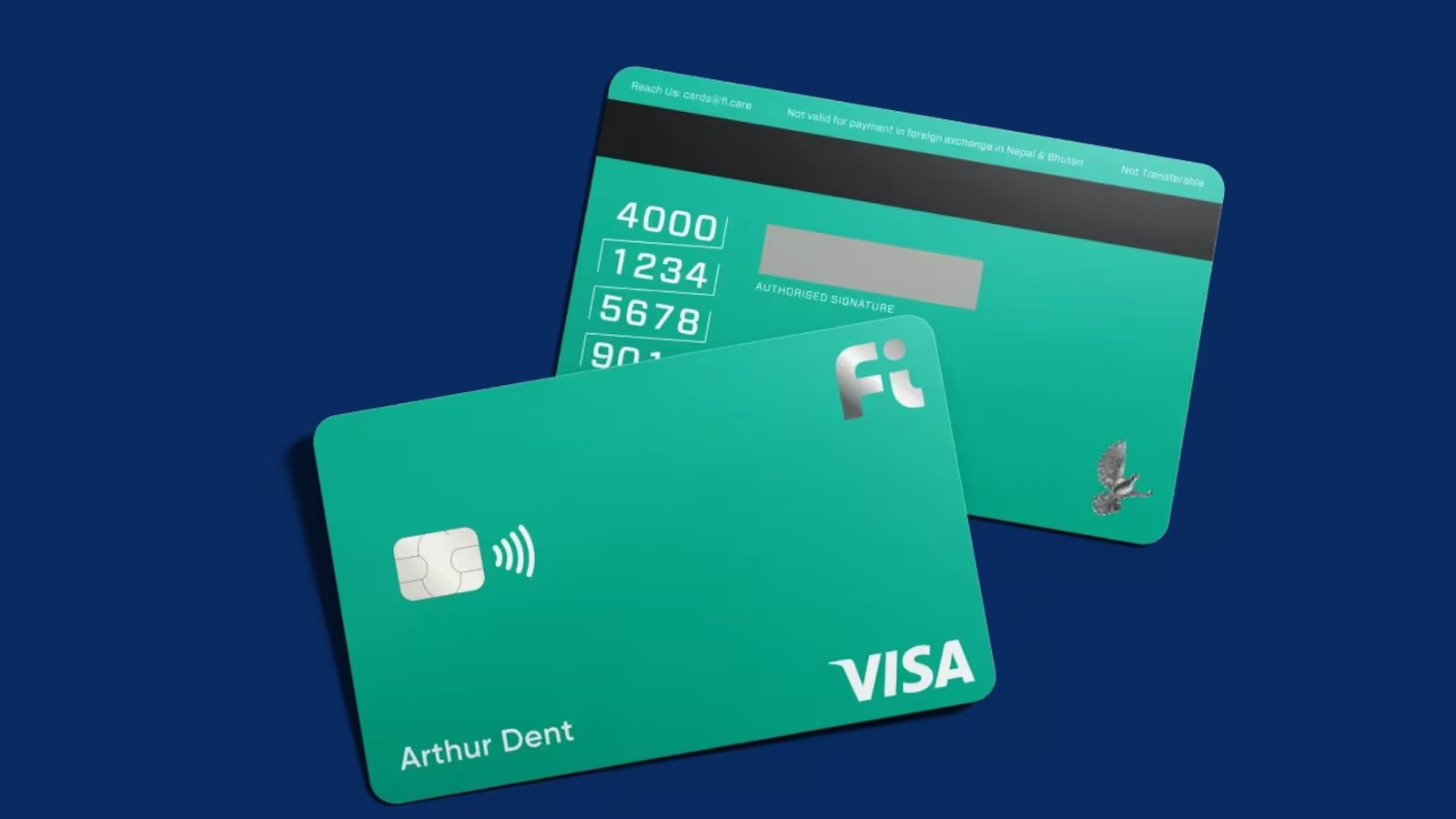
Fi Money, one of India’s more promising neobanks, is winding down its banking services after four years — redirecting its 3.5 million customers to Federal Bank’s own app, FedMobile.

The company raised ~$169M, counted Sequoia (Peak XV), Ribbit Capital, and B Capital among its backers, and processed over a billion transactions. By most metrics, that’s a meaningful run.

But the retreat tells an interesting story about the neobank model in India.

Building on top of a licensed bank’s infrastructure is both a feature and a constraint.

Fi never owned the underlying banking relationship — Federal Bank did. When strategic priorities diverge, the fintech layer becomes the expendable one.

Fi’s co-founder Sujith Narayanan hinted at this pivot last month — framing the future around “deep technology and AI systems for startups and enterprises.” The banking product isn’t shutting down because it failed operationally. It’s being deprioritized in a strategic realignment.

A few things worth noting here:

→ India’s neobank space (Jupiter, Slice, Open, Fi) has faced persistent pressure around monetization. Without a full banking license, the revenue levers are narrow.

→ Pivoting to B2B infrastructure/AI is a well-worn path for consumer fintechs that hit a growth ceiling. Whether Fi can execute that transition is the real question.

→ 3.5M users is substantial. How many of them migrate smoothly to FedMobile — and how many simply churn — will be a case study in what neobanks actually own: the product, or the relationship.

The neobank thesis in India isn’t dead.

But it’s clearly being stress-tested.

What’s your take on the Neobanks ?

CRED’s RBI License: A Game Changer for Payment Aggregation

CRED just got the payment aggregator licence from RBI and this changes the game for CRED super app and even for Kunal Shah.

It means

  • CRED can now onbaord merchants directly and collect payment across UPI, Credit, Debit and Netbanking – No middlemen involved
  • It can handle all the settlement & refunds individually, under RBI supervision.
  • CRED has now PPI Licence , TPAP licence, SEBI Licence and corporate agency licence (IRDA)

The numbers backs the milestone :

  • ₹8.5 lakh crore in payments processed in FY25
  • 1.5 crore users on platform
  • 1 in 3 credit card bill payments in India goes through CRED

What started as a credit card rewards app in 2018 is now one of India’s most regulated — and credentialed — fintech platforms.

Kunal Shah put it best: “The authorization reflects the trust we’ve consistently built across the ecosystem.”

The next chapter of CRED isn’t just about rewarding users.

It’s about owning the payment rails for India’s most creditworthy segment.

CRED #Fintech #RBI #PaymentAggregator #KunalShah #IndiaFintech #Startup

Affordable Luxury: Why Choose Palmonas Jewellery?

Most jewellery sits in the box but Palmonas wants you to live it everyday.

That’s the idea behind the Pune based brand that took Shark Tank season 4 by storm and not just the hype.

What is Palmonas ?

Palmonas is a demi-fine jewellery brand. That’s the sweet spot between cheap fashion jewellery (that turns your skin green) and fine jewellery (that costs a fortune and sits locked away). Think real quality, real design — but at a price you can actually afford.

It was started in 2022 in Pune by Pallavi Mohadikar and Dr. Amol Patwari. Bollywood actress Shraddha Kapoor joined as a co-founder — not just as a face, but as a real stakeholder with 21% equity in the company.

The Shark Tank Moment

On Shark Tank India Season 4, the founders asked for ₹1.26 crore for just 1% equity — valuing the company at ₹126 crore. Bold? Yes. Justified? The sharks thought so.

Sharks Namita Thapar and Ritesh Agarwal made the deal happen at full ask. Why? Because the numbers were real:

  • ₹3.8 crore revenue in FY 2022–23
  • ₹6 crore in FY 2023–24
  • ₹13.5 crore in just the first half of FY 2024–25
  • Sales projected to hit ₹30–35 crore for the full year

That’s not slow growth. That’s a rocket.

What Makes Palmonas Different?

Here’s where it gets interesting. Palmonas isn’t just another pretty jewellery brand. They’ve done a few things that most brands haven’t.

1. It’s actually built for daily wear – The jewellery is waterproof, tarnish-proof, and skin-safe. You can wear it in the shower, at the gym, at work — anywhere. Most brands can’t say that.

2. The quality is real, not just marketing– Pieces are made from stainless steel or 925 sterling silver with 18k gold plating that is 2.5 microns thick — five times thicker than standard gold-plated jewellery. It’s built to last.

3. The price is actually fair -Palmonas jewellery starts at around ₹800 and goes up to ₹5,500. You get something that looks and feels premium, without spending what you’d spend on real gold.

4. A lifetime warranty on plating-Not many brands offer this. Palmonas stands behind the quality of every piece — which says a lot about how confident they are in what they make.

5. Designed for stacking and layering– The whole collection is made to mix, match, and layer. It’s not one big statement piece. It’s jewellery you build and make your own — which is exactly how Gen Z and young millennials like to wear it.

What’s the USP in One Line?

Real quality. Everyday wearability. Affordable price. No compromise.

That’s the gap Palmonas fills. Fine jewellery is too expensive for daily use. Fashion jewellery is too cheap to last. Palmonas sits right in the middle — and owns that space.

Where Are They Headed?

After Shark Tank, the brand raised ₹55 crore in Series A funding from Vertex Ventures in August 2025. Big plans are underway:

  • 100 new stores opening across India
  • Expansion of their 9kt gold demi-fine collection
  • A push from online-only to a full offline + online brand
  • Already shipping to 200+ countries

They’ve fulfilled over 6.5 lakh orders and show no signs of slowing down.

Should You Check It Out?

If you’re tired of jewellery that fades, breaks, or costs too much to wear every day — Palmonas is worth a look. It’s jewellery that’s made to be worn, not saved.

Amazon just entered healthcare — and it might answer your health questions before a doctor does.

Amazon can now answer your health related questions –

Yes, you heard it right Amazon has just launched Amazon Health AI – A tool that answer your all health related questions on its website and app.

Plus, you don’t need prime for it or any other kind of special membership.

What it can do ?

You can type in health related queries and get real time answer –

  • Answer basic health question
  • Read and explain your lab result
  • Help you renew a prescription
  • Book a doctor visit
  • Connect to a real doctor if required 

Plus, if you share your health records it can share customized details for it.

What If You Have Prime?

Prime members get up to 5 free chats with a real doctor for things like colds, allergies, pink eye, UTIs, and more. No Prime? You can still talk to a doctor — you just pay per visit.

Is It Safe to Share Your Health Info?

This is the big question. Amazon says your data is kept safe and private. They say they don’t use your name — only patterns, like “many people ask about this drug” — to make the tool smarter.

But Amazon hasn’t shared full details on who can see your chats. It’s worth thinking about before you share anything personal.

Other Big Names Are Doing This Too

Amazon isn’t the only one. OpenAI launched a health version of ChatGPT in January. Anthropic did the same shortly after. This space is moving fast.

Should You Try It?

If you want a quick, easy way to get health info — or to understand a confusing test result — it’s worth a look. Just don’t use it instead of seeing a real doctor.

Sign up at amazon.com/health-ai.

Access is rolling out slowly, so you may get an email when it’s your turn.

FamApp: Empowering India’s Youth with Digital Banking

FamApp (formerly FamPay) — two IIT graduates who spotted the biggest unserved market in Indian fintech while still in college.

40% of India’s population is under 18. Millions of them are already transacting — booking food, buying groceries, paying for subscriptions.

But without a bank account, they had no financial identity. Every payment required a parent’s card, OTP, and permission. Nobody had built a product for them. Until two IIT Roorkee graduates decided that was the most fixable gap in Indian fintech.

FamApp (formerly FamPay), founded in 2019 by Sambhav Jain and Kush Taneja, is India’s first neobank for teens — now a spending account for everyone aged 11+. Their flagship product: a numberless prepaid card + UPI ID that lets anyone transact independently, without needing a bank account.

In India, you can’t open a bank account under 18. But teenagers are already digital-native buyers. The result: they either borrow parents’ cards or stay locked out of digital payments entirely — with zero financial literacy or independence built along the way.

“FamCard is the first card a teen ever holds — like their first bicycle. It’s their first step at being responsible with money.” — Kush Taneja, Co-founder

Parents onboard the child with consent, load money into the FamX spending account, and set visibility on transactions. The teen gets a numberless physical card (no card details printed — everything lives in the app) + a custom UPI ID. Payments clear in under 2 seconds. Every transaction is device-lock protected — fingerprint, Face ID, or PIN.

Built on NPCI’s UPI rails, powered by Visa, RuPay, and Trio.

NFC tap-to-pay, QR scan, and personalised UPI IDs with custom QR themes.

Gamified FamCoins rewards loop drives daily engagement. The app is designed to feel like Instagram — not a bank. Interchange fees on card transactions, premium membership tiers (Classic → Ultra), and brand partnerships — FamApp positions itself as the gateway for brands to reach Gen Z before any other platform does. By FY25, the company reported ₹90–100 crore revenue and ₹10–12 crore profit before tax — turning profitable after years of building.

Word-of-mouth within schools and friend groups. Gamification and rewards that make sharing natural.

A community layer built directly into the app. 10M+ registered users reached with zero traditional advertising — just product-led growth targeting the most social demographic in India.

Every fintech in India was chasing the same adult customer. FamApp went the other direction — acquiring users at 13, building loyalty for life.

Today’s 13-year-old FamApp user is tomorrow’s salaried professional.

Win them first, keep them forever.

FamApp didn’t chase India’s banking market — they built the pipeline to it.

MEET GEMINI IN CHROME – GOOGLE JUST MADE CHROME SMART

Google just embedded Gemini directly into Chrome — and it’s now live in India, Canada, and New Zealand.

Not as a separate app. Not a new tab. A sidebar that lives alongside everything you do online.

Summarize pages. Draft emails without leaving your browser. Compare products across tabs. Connect to Gmail, Calendar, YouTube, and Drive for contextual answers.

What really stands out?
Support for Hindi, Bengali, Tamil, Telugu, and 4 other Indian languages. Google knows the next billion AI users won’t be typing in English.

The browser is no longer just a window to the internet. It’s becoming an intelligent layer on top of it.

And Google — with Chrome on billions of devices — may have the distribution advantage which no AI competitor can easily replicate.

The agentic features (AI that acts autonomously on your behalf) are still US-only for now.

But they’re coming.

#gemini #geminichrome #chromegemini #geminiai

Decoding startups and brands: the problem they solve, how the product works, and how the business makes money.

Share via
Copy link